Thursday, March 15, 2012

Social Media and the Republican Primaries: To know you is not to love you


I was intrigued by the recent Ad Age article which looked at the correlation between social media and primary results and concluded that social media was not predictive (yet). So I decided to do some research on my own.

First things first, I was struck by the huge difference in social media between President Obama and the current four Republican candidates.

Mitt Romney tops the Facebook “likes” scale at 909,600. President Obama has 25 million.

Newt Gingrich tops the Twitter followers scale at 1,500,000. President Obama has 13,000,000

So, right off the bat, if social media is a good sign of election results, these guys are fried.

The four candidates, together, have 2,885,000 “likes” to President Obama’s 25,600,000 and 2,449,000 Twitter followers to President Obama’s 13,000.

However, the four candidates, together, have put out 7,340 Tweets to the President’s 3,130. So, could there be a mathematical correlation there?

I looked at the number of states currently having held primaries but excluded four huge economies: American Samoa, US Virgin Islands, Guam and the Northern Marianas Island. With those important economies out of the way, Romney has 15 victories (58% of the total), Santorum has 9 (or 35%) and the rest have 2 (or almost 8%)

So, Facebook v Wins... nothing there:


There’s just no rhyme or reason between the percentage of wins for each candidate and their Facebook “likes”. Ron Paul has almost 1 million “likes” and 0 wins; Santorum has almost no “likes” (179,800) but is the second largest winner.

So I looked at Twitter


Gingrich –a well know firebrand—has the most Twitter followers at 1.5 million while winners Romney and Santorum have only 377,800 and 166,500 followers respectively. So, excluding Ron Paul, there seems to be a perverse reverse correlation.

And when we look at the number of tweets, the relationship becomes a bit clearer:
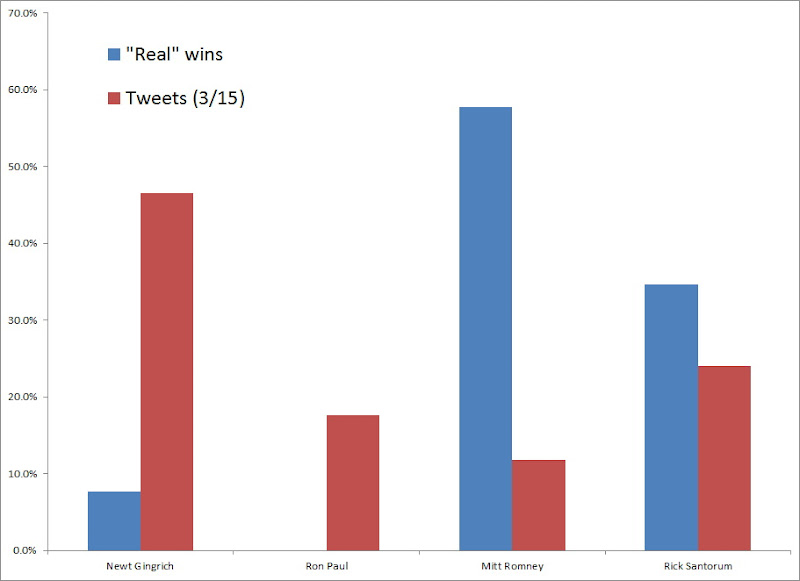

When looking a the number of Tweets, we find the same perverse relationship: excluding Ron Paul, the more candidates “twitted” the less states they won.

So, evidently, the more they Tweet and the more we know about these candidates... the less likely we are to vote for them.

As a reminder... the four Republican candidates together have issued 7,342 Tweets... President Obama has only issued 3,130, well under 50%.

So, can social media predict an election? Perhaps, in a perverse kind of way... it might.

Saturday, March 3, 2012

Real Branding vs Really? Branding?

I've got to confess: the first ever real ad I remember... and one of the seminal ads in getting me into advertising, was from the 70's and showed a beautiful apple with an Alfa Romeo key inserted in it and the keychain with the Alfa logo dangling. Needlessly, it said: Temptation.

That ad got me hooked into advertising and communications. It was incredible how a brand could both, tell you what it was all about AND entice you with such an economy of words and a powerful image.

A second classic ad that impacted me was this one:


That's right. The mythical "commendatore" Enzo Ferrari drives a Fiat. Of course, he doesn't drive the Fiat shown... or any other "Fiat-branded" car. But, in 1970, when Fiat bought Ferrari, it was huge news and this single ad changed the entire perception of Fiat among thousands of car enthusiasts likey myself. After all, how can Fiat not learn and improve from Ferrari?

That was real branding.

Fast forward to today and we now see that the makers of this beauty:


A Pininfarina-designed Maserati GT --which by the way, has a 400+ HP Ferrari engine-- had the bright idea of coming up with this:


Which brings three questions to mind:

  1. If I just spend $130,000 in a GT... do I really want my neighbor to have a $35,000 version made by Chrysler?
  2. Is the U.S. ready to spend $35,000+ in a car with a 1.4 liter, 4 Cylinder engine that puts out 160 HP? I mean, even a Mini Cooper S has 180 HP.
  3. Why would Maserati even do this? Why put yourself in a position where a Mini or a Honda Civic can beat a Maserati from 0-60 or, more probably, from one stop light to the next? What were they thinking?
Now... Maserati has a long history of doing weird alliances. These alliances have gone from the sublime to the ridiculous.

In the 70's, this car was a sublime example of a great alliance:


The car was a Citroen SM and had a Maserati engine and enough advanced engineering to shame a modern car designer: speed sensitive power steering, headlights that turned with the steering, 6 speakers... it was expensive, fast, luxurious and did wonders to bolster both, Citroen's and Maserati's reputations.

Then came this doozy:


A Chrysler TC... a thinly-disguised K-Car, the laughing stock that saved Chrysler the first time and the platform that helped cement the brand the ultimate purveyors of Mini Vans and other castrating vehicles.

After that car, no one, but no one, bought a Maserati in the U.S. The brand just basically vanished.

The car was under-powered, ugly, full of design miscues.

And, now, in a stroke of genius, Maserati is going to destroy its image again.

Certainly brings new meaning to the old phrase regarding those who ignore history...


Short Hiatus - New Agency is Born

Back after a short hiatus.

On Dec. 31st the agency where I used to work closed its offices after losing its largest client and was reborn as a media rep firm

After a short vacation, Carlos Montaño, the creative director and one with whom I've worked at 3 different agencies in Miami and New Yori, and I, decided to take the plunge and form a new venture: Montano + Salup Communications.


So that's our new logo, a gift from talented designer Carolina Angel (http://www.lovetob.com/) and here's our new website: www.montanosalup.com


Goes without saying that we will deeply appreciate referrals. My new business email is msalup@montanosalup.com

Monday, December 5, 2011

The Grain of Salt

One of the things I used to love about the radio business is that everyone was #1 at something.

Radio reps would come see you and, with an absolutely straight face, would say things like "Well, we're Number 1 in blond women who own Corvettes" or in "Hispanic Black Gay Males who also go fishing in the weekend" or some other incredible convoluted target.

And, to be fair, all media did it. We'd have magazines who were "Number 1 in fortnightly publications who come out on Wednesdays", cable networks who would imitate radio (Number 1 in Hispanic Asian Women who cook for families larger than 5 members and also had an MBA") or something.

I always told my media directors: Sit back. Take a breather. And ask yourself "does it make sense"? Then do a bit of research.

So I was happy to see this gem courtesy of Vme


I mean, it's still impressive, #2 and a far #2 compared to Telemundo.

Impressive, yes, but a bit misleading.

What is it running against?

Univision has "Muchachitas como Tu" Sundays from 9-10 and clearly delivers 4 times more audience. But... #2. I mean, not bad, right?

Telemundo runs "Pearlie", a cartoon aimed at what looks to be 5-9 year old girls and so cloying that a mom would have to be really dedicated to sit down with their 5 year old to watch it.


Galavision doesn't have programming from 9:00 - 9:30, it runs infomercials. At 9:30 it then runs "Al Sabor del Chef"

Telefutura runs "Plaza Sesamo" also aimed at what, 5-10 year olds?

Discovery? Clear VME win. They run animal shows.

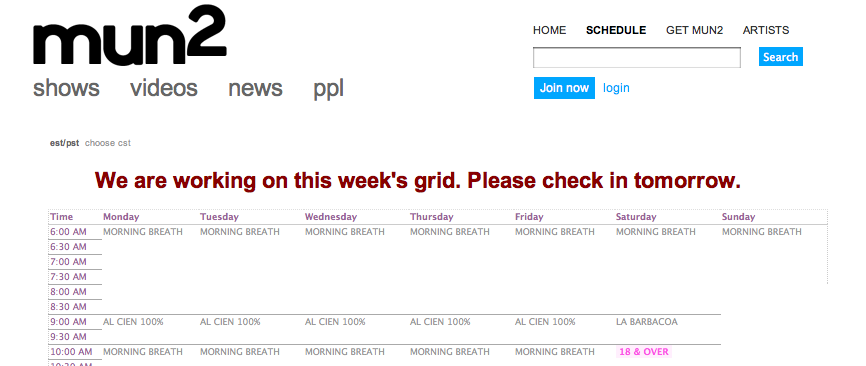
Mun2? Morning Breath. Clear VME win. Then again, Mun2 is so on top of it that, on Monday at 5pm they were still "working on this week's grid". Really.


And Azteca America doesn't even show programming on Sundays at 9:00am, so, infomercials.

Bottom line: Any time you see a statistic like VME's, which clearly, doesn't make any sense a priory, take a couple of shots of salt and go to the bottom of it.

Thursday, November 24, 2011

Why the web demolished newspapers as news sources

This was the view on Thanksgiving... maybe 4 or 5 times more FSI's than actual news. And even the actual news sections were full of ads.


Given the scant amount of actual news, any doubts as to why just about everyone gets his/her daily news fix on the web?

Wednesday, November 16, 2011

Lame Cliché Thinking – Reboot!

In what seems to be a time-honored tradition, one more consultant warns that “Holiday Season Price-Cutting and Hard Sell Can Damage a Brand”

http://adage.com/article/cmo-strategy/holiday-season-price-cutting-hard-sell-damage-a-brand/231023/


It’s time to re-examine that myth.

#1 – Price –not sex—sells.

Time Magazine reports that, for the first time in 20 years, the percentage of the population employed in the U.S. is lower than in the U.K., Germany and the Netherlands.

The Govt. Poverty Line being set at $22,350 for a family of four. In September 2011, the Census Bureau reported that there are 46.2 million people living below it, an increase of 2.6 million people from last year.


The New America Foundation estimates that the share of middle-income jobs fell from 52% in 1980 to 42% in 2010.

So, first things first… today, if you are not on sale, you are not selling.

As I reported previously in this blog (http://salupmedia.blogspot.com/2011/09/braman-miami-how-to-destroy-and-image.html) even Bentleys and Rollers are advertised on price. A practice that, by the way, I don’t agree with, but they appeal to the upper 1% of the upper 1%.

#2 – When is a “brand” not on sale? When the retailer sells it.

Think about your day-to-day brands… the Nikes, Colgates, Crests, Pantenes, Folgers, Thomas English Muffins, Smuckers, Coca Colas, Budweisers, Canons, Sonys, Panasonics, iPads and the other hundred premium names that surround us in real life.

One of the common elements that they all have is that they are sold through retailers, be it your local Foot Locker, Publix, Ralph’s, Best Buy, Brands Mart and, naturally, Walmart.

Do you honestly think that Coke went flat, Thomas English Muffins grew moldy and Nikes are less desirable because a retailer decided to offer a discount or BOGO? Nah.

Do you really think that Macy’s shoppers will blame Polo for long lines at the register? Or for the crowding in the corridors? Nah. They’ll blame Macy’s.

Real consumers understand both concepts to the “t”. If not, they wouldn’t even bother using coupons to buy name brands, they would just buy the store brand for less money.

If you want to think nuclear damage to brands think Walmart, Costco and their brethens. And not because they sell brands cheaply (people see that as a benefit) but because in driving all profits from brands, they dis-incentivate brand creation. Why brand your Kellog’s Cereal Bars if you are going to make a few cents per sale? You might as well create more store brands!

So, most of the time, it’s not the brand that’s on sale… it’s the retailer holding a sale.

#3 – The brand “experience”

Go back to the brands that surround us on a daily basis… and what is another huge common element? Their transactional nature.

I go to Publix… then buy shampoo (Pantene), toothpaste (Colgate), coffee (Bustelo or Pilon Black), chicken (Purdue), soft drinks (Gatorade or Propel Zero), bananas (Chiquita)… and dozens of other products. All branded. All transactional.

I definitely like these brands –and go out of my way to buy them—but there’s no experience, just a transaction. A branded transaction, to be sure, but a transaction nevertheless.

More… my wife goes to Macy’s (a brand) and buys Clinique makeup. Again, transactional… she is replacing make up.

From a regular consumer point of view, I’d say that 90% of all brand “experiences” are transactional. Branded. But transactional.

#4 – So why brand?

A brand only has one purpose in life: get a consumer to pay a premium for what would otherwise be a parity product (think store brand, Sear’s sneakers…)

Branding as a discipline only has one purpose: get the brand to be in as many transactions as possible.

From my experience in consumer research in stores, restaurants, supermarkets, pharmacies… consumers can tell what brands stand for and what retailers do to them.

Moreover, consumers can tell very well when a brand is relevant and when it isn’t and make many of the store-brand decisions based on that mental map. I would venture to say that, whenever a store brand wins over name-brands, the name brand hasn’t done its job well.

Bottom line: There are so many lame clichés around the entire issue of branding and discounting that it’s time to try to see it from the consumer’s point of view:
  • Discounts are seen as a regular event today; needed and welcomed
  • Most discounts are seen –correctly—as coming from the retailer
  • The consumer seems to be differentiate well between a brand’s activities and a retailer’s
  • Consumers also seem to have no problem in determining when a product should be branded and when it doesn’t matter

Monday, November 14, 2011

Contextual advertising gone horribly wrong

Let me be clear. I am 100% in favor of every modifier in online advertising. Geographical. Behavioral. Conteextual. You name it, if it can help me focus my message, I'm there.

But wow, there must be some way to avoid this:


I am sure that the Motorcycle Superstore wants nothing to do with a picture of a supposed motorcycle crash victim with the head split open, brains spilled out and a bike very visible in the picture.

I have seen (less, way less, extreme) cases where I might type "escalate" as in "escalate a problem" only to be rewarded by banners from the Cadillac Escalade.

Wow.